Building the operating systembehind creator workflows.
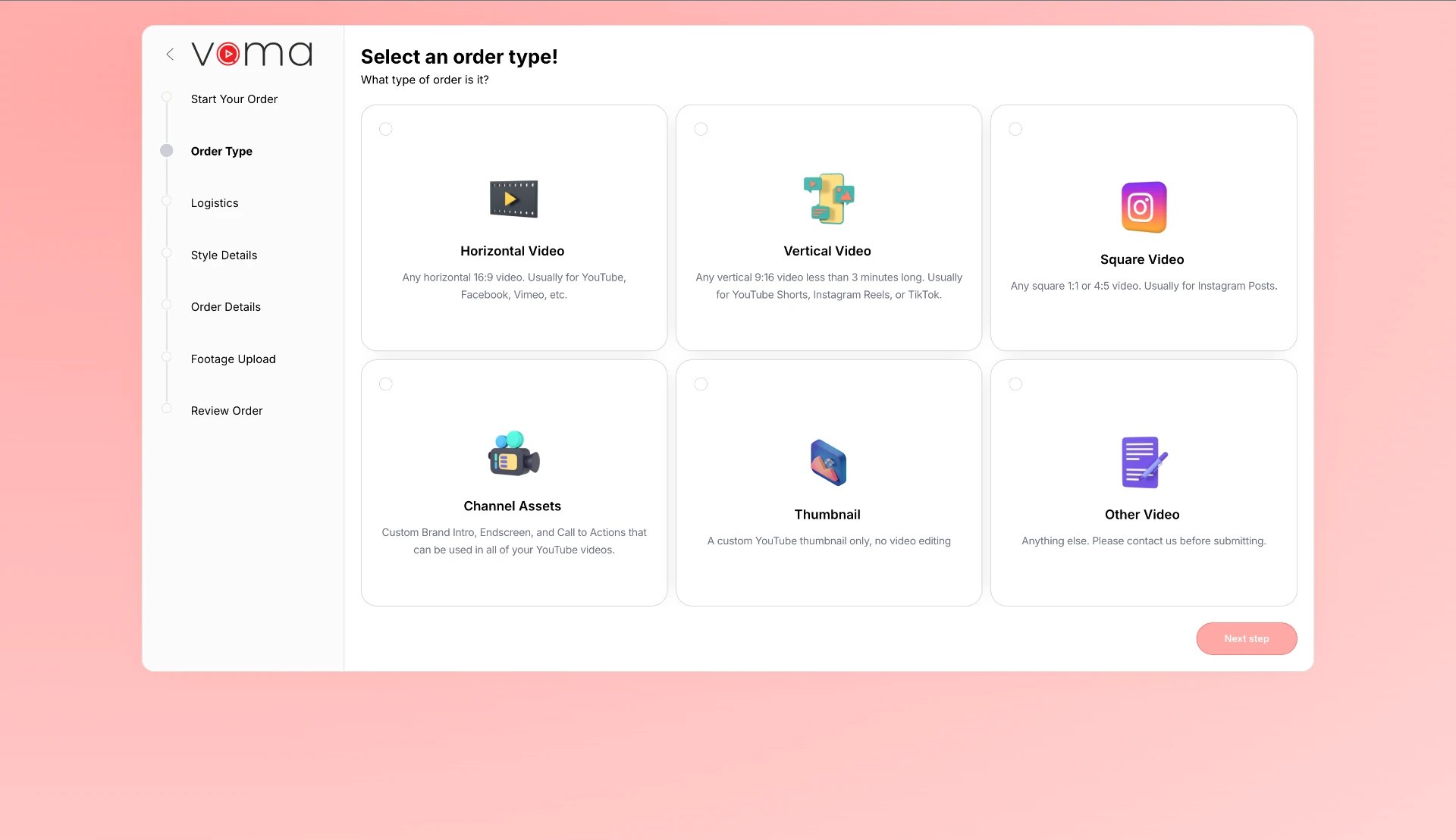
VOMA is the product platform Tasty Edits uses to coordinate creator operations — bringing content workflows, collaboration, analytics, automation and AI-assisted tools into one connected system.
My work sits across the product: translating operational problems into usable experiences, building the systems behind them, and continuously improving how the platform performs as those workflows grow.
One platform. A lot happening underneath.
VOMA supports the operational work required to manage content production for creators.
Rather than treating content management, analytics, communication and operational workflows as disconnected tools, the platform brings them into a shared product environment.
That means the product has to work for several kinds of workflows at once — from managing orders and deliverables to analysing YouTube performance, understanding audience comments, collaborating with teammates and turning large amounts of data into something genuinely useful.
My role has increasingly been to help turn those operational needs into working product systems.
Complex operations shouldn’t require complex experiences.
Creator operations involve a surprising number of moving parts.
Orders need to progress through different people and stages. Editors and thumbnail artists need the right information. Managers need visibility. Creators need useful performance information. Teams need to communicate. YouTube data needs to be collected and interpreted. Repetitive operational work needs to happen without someone manually pushing every button.
As VOMA grew, the challenge wasn’t simply adding more features. The challenge was building those features so they could work together without making the product increasingly difficult to use, maintain or scale.
Make the experience simplerwhile the system underneathbecomes more capable.
VOMA serves several participants in the creator-content workflow.
Need visibility into their content, performance, tasks and collaboration.
Coordinate editors, thumbnail artists and production workflows.
Work through assigned video deliverables and production requirements.
Manage artwork-related deliverables and feedback.
Need oversight, reporting, automation and tools for managing the broader system.
Not one layer of the product.
My work on VOMA doesn’t sit neatly inside a single discipline.
I contribute across product development, UX implementation, Bubble architecture, backend systems, APIs, automation, AI-assisted features, performance optimisation and product planning.
A typical feature can start as an operational problem, move through interface and workflow decisions, require changes to the database and backend architecture, connect to an external API, introduce an AI processing layer, and finally need monitoring and optimisation once real data starts flowing through it.
That end-to-end involvement is the part of product development I enjoy most.
I don’t just build the screen.I build what has to happen after someone clicks it.
Turning operational requirements into usable product features.
Designing frontend, database and backend workflow structures.
Building AI-assisted analysis and productivity workflows.
Connecting external services and synchronising product data.
Reducing repetitive operational work through backend systems.
Making increasingly capable workflows remain understandable.
Auditing and improving expensive or slow product architecture.
Creating dashboards, historical data and decision-support tools.
Contributing to feature planning and technical implementation decisions.
The interface and the system are one problem.
On VOMA, product design frequently happens alongside implementation.
A workflow that looks simple on-screen can have implications for permissions, data relationships, backend workflows, API limits, workload usage and performance.
Because I work across both sides, implementation constraints can inform the UX early rather than appearing as surprises after a design has been handed over. Likewise, technical architecture isn’t allowed to dictate a poor user experience simply because it is easier to build.
The goal is to find the point where both sides work.
Good UX above.Good systems below.
VOMA is built in Bubble, but the product extends well beyond frontend workflows.
Features can involve database architecture, backend workflows, recurring processes, external APIs, AI models, data aggregation, reporting and asynchronous processing.
As the amount of data and automation grew, architecture became increasingly important. My work includes evaluating how data is loaded, how repeating groups query information, where calculations happen, how backend processes are structured, how AI jobs are broken into steps, and where unnecessary workload can be removed.
- User Interface
- Product Workflows
- Bubble Data
- Backend Jobs
- External APIs / AI
- Processed Data
- Reporting / Product Experience
A simplified representation — not the architecture of every VOMA feature.
Turning thousands of comments into something useful.
Audience comments contain valuable signals, but reading and interpreting them manually does not scale well.
I worked on VOMA’s Video Comments tooling to help transform raw YouTube comments into structured information creators and teams can actually use.
The important challenge wasn’t simply generating AI responses. It was creating a workflow where comment data could be processed, classified, stored and surfaced in ways that remain useful inside the product.
Making channel performance understandable over time.
Channel Data gives creators a clearer view of how their YouTube channel is evolving. I worked on expanding this into a historical analytics system rather than a snapshot of current numbers.
The product stores monthly channel statistics and supports comparisons across views, watch time, subscribers gained, likes and comments — alongside derived ratios including views-to-subscribers, comments-to-views and likes-to-views.
The system also compares current and previous periods and uses AI-generated insights to help translate the numbers into useful observations.
The underlying challenge involved both product presentation and data architecture: collecting recurring data reliably, storing historical records, calculating comparisons safely and presenting the result without overwhelming the creator.
From individual videos to structured performance intelligence.
Video Data brings video-level performance information into VOMA so teams can evaluate content within the same environment where the rest of the creator workflow happens.
My work has included developing and improving the workflows that collect, process and present this information, while also addressing the performance implications of increasingly data-heavy features.
Turning a dashboard into a useful starting point.
As VOMA accumulated more capabilities, the creator dashboard needed to do more than display information. I worked on product improvements designed to surface what matters first.
The challenge is prioritisation. A dashboard containing everything is rarely useful. The work is deciding what deserves attention now, what can remain contextual and how creators can progressively discover deeper information.
Making complicated production workflows feel manageable.
Content production moves through different roles, orders and deliverables. As these datasets grew, some existing interfaces became increasingly expensive and slow to load.
My work included auditing the architecture behind these workflows and evaluating different ways of improving performance without compromising the operational model.
This is an example of where product development becomes more than adding another feature. Sometimes the product work is making the system underneath an existing feature dramatically better.
AI as infrastructure, not decoration.
AI inside VOMA is used to help teams interpret information and reduce repetitive cognitive work.
Rather than treating each AI call as an isolated prompt, the work increasingly involves designing reliable processing systems around it — preparing inputs, breaking large jobs into manageable steps, storing outputs, handling failures and making the result useful inside the product.
The AI call is the easy part.The product around it is the real work.
- YouTube Data
- Collection
- Processing
- Analysis
- Stored Insight
- Creator Experience
- Audience Comment
- Classification
- Sentiment / Intent
- AI Assistance
- Actionable View
- Operational Event
- Backend Workflow
- Automation
- Data Update
- User Feedback
Building more without making everything heavier.
More creators, comments, videos and historical data mean increasingly expensive queries and workflows.
Multiple user roles and interconnected workflows need to remain understandable.
Long-running or data-heavy AI operations need reliable processing rather than fragile one-shot workflows.
A significant part of my work has therefore involved optimisation — examining where data is loaded, how jobs are processed, how features interact and where architecture can be simplified before scale turns small inefficiencies into large ones.
A product that keeps becoming more capable.
My contribution to VOMA has grown from individual feature development into broader responsibility across the product’s systems.
The work has helped bring analytics, AI assistance, operational automation, collaboration and creator workflows into a more connected product environment.
More importantly for me, VOMA represents the kind of work I want to keep doing: understanding the product problem, designing the experience, building the underlying system, and then improving it once reality starts testing the assumptions.
Design it.Build it.Watch it break.Make it better.
What building VOMA keeps teaching me.
A capable system does not have to feel complicated to the person using it.
A workflow that takes too long or costs too much to run is not finished simply because it technically works.
Many implementation problems can become better product decisions when both sides are considered together.
This is where designmeets the system.